
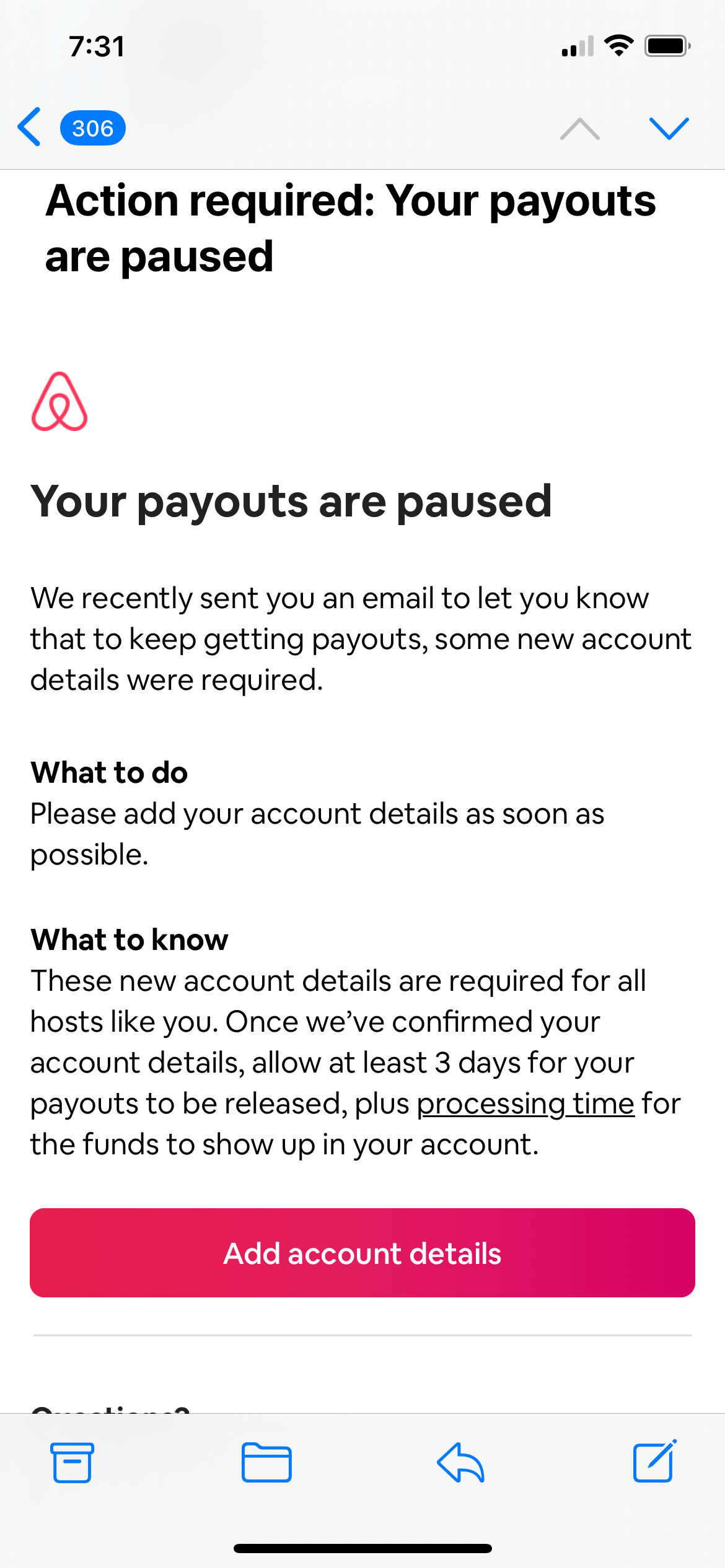
I got an email today that made me a little suspicious. I can always call them to make sure it’s legit but I wondered if anyone else received a notice that Airbnb wants you to update all your financial info. I wonder if this might have to do with the fact that they’re going to be taking a larger cut in October.
2 Likes
Did you check your account directly to see if there are any notifications asking for that information?
I never respond to any email inquiries, nor click on any links etc. - just go to the account directly to make sure everything is in order.
4 Likes
Go to your Airbnb account and make sure all the information is filled in, etc. A pop-up should come on and ask you to fill-in whatever is needed.
Depending on your email carrier, you should be able to check the email’s header to see if the actual sender of the email rather than the one you see in your mailbox.
Search Google for ‘[your email client e.g. Outlook] view headers’ and you’ll get a page something like this which will explain how to do so.
1 Like
Definitely don’t click on that email link. If it’s legit, the request to update your info should appear in your notification messages in your hosting account.
If it doesn’t, it’s probably a scam. Phone Airbnb to check and report.
2 Likes
I’m guessing I have missed something major here - what is the deal on Airbnb increasing their cut?
Deleted by poster. 2020
I read it somewhere, maybe on Facebook site for hosts. I can’t locate it so hopefully it’s wrong. What I read was that Airbnb was going to chop off 12% as opposed to 3% of what their take is from hosts’ net $$. I doubt if I expressed that well and since I can’t find the information, I wouldn’t worry about it.
People spread all kinds of rumors. I read somewhere they were going to up the host fee from 3% to 3.5%, so who knows. All we can do is wait for an official announcement.
In October, hosts that are integrated via PMS (property management software) will be required to use the single fee model. That used to be called simplified pricing, and it is where the host pays all the fees. The fee to be charged is 15.5% of the total of the rent plus fees (such as cleaning, pets, etc.).
Airbnb worded the announcement poorly. It was easy to conclude that ALL hosts were going to be required to use the single fee model. They clarified the announcement a few days later, but the damage had been done.
1 Like
Airbnb really needs to pay for better copy writers. So much of their stuff is clunkily worded, and confusing, when it certainly doesn’t need to be.
I gave them feedback about the wording of their “prep days” explanation years ago, they have never changed it, and I still see newer hosts on forums reasonably misunderstanding it.
For a 1 day prep day, it says “Block one night before and after every reservation”, which sounds like you’ll end up with 2 nights blocked. It does technically block one night before and after, but what they don’t explain anywhere is that the blocked night after Booking A doubles up as the blocked night before Booking B.
What is so hard about just saying “Blocks one night between bookings”? Since that is exactly what it does.
1 Like
Here’s an update. I’m sorry if I scared people by writing the Airbnb plan to grab a higher percentage from hosts. I misinterpreted something that I read from another Airbnb forum. I was relieved that this is not going to take effect.
Secondly, the email I received saying that my payments would be paused until I updated some financial information: I phoned them and found out it was not a scam after all so I made a couple of updates and now everything is fine.
I really appreciate the feedback I get from hosts on this forum. Thank you.
3 Likes
This can also be misleading, because the interval between two bookings is not necessarily equal to one day; it can be longer. In such cases, the phrase ‘blocking one day between bookings’ lacks a clear definition.
2 Likes
Well, I don’t think that part is confusing- of course you might not have a full calendar- I doubt most hosts do, so there would sometimes be several nights between bookings. But the prep setting would only block one night of that stretch, the rest would be open.
I don’t feel comfortable leaving it up to them to decide which unbooked day between two reservations should be used as a preparation day. If they change the wording as you suggested, it would effectively give them too much freedom to manipulate or do mistakes in our unbooked calendar. For me, it’s essential to have one full day before a reservation to prepare properly, and one full day after to handle any unexpected issues, which are quite common.
Ideally, if these two preparation days overlap, that’s even better, as it means we have excellent occupancy without compromising readiness. I hope I managed to explain better this time.
Any lack of definition can be a huge pain when arguments arise.
I understand your point, but blocking one day between is true if they block any random day between two weekend bookings, for instance.
Of course there are owners who can easily deal with same day bookings, it’s about how much help do they have from their team, they can opt to have no blocked days between bookings.
Yes, the wording would allow for that, but I can’t imagine why Airbnb would just block some random day between 2 bookings that are a week apart- they want bookings and their service fee.
As you say, of course they could just use my suggested wording as an excuse for their system glitching and blocking a random night.
So they could keep the wording they now have, but at least explain that the “night after” Booking A will double up as the “night before” a subsequent booking that is only one night after the blocked “night after”- that the 1 night prep time won’t block 2 nights in a row, which is what is confusing to hosts.
I have always used the one night prep time and it has never glitched out. No way I want to do same day turnovers.
It has only been an issue for me once, when I had to get up early to turn over the room, as a guest checked out late in the afternoon one day and I had another guest coming in at 11am the next day.
This wouldn’t be an issue for most hosts who have standard check-in times of mid-afternoon and check-out times of 10-11am.
But my check-in times are 11am-11pm and check-out by 4pm.
Of course I could change that, but for various reasons, that almost always works out well for both me and my guests. Only a couple of times over all my years of hosting has a guest checked in before mid-afternoon or checked out as late as 4, because of the flight arrival and departure times here.
Scam. HipCamp message said the same. Hip Camp management was on it in a nano second warning hosts not to respond.
Did you ever find out what email address the scammers were using? I’m wondering if the supposed Hipcamp and the supposed Airbnb scammers were using the same address.
If you know the email addesss, that would really help other hosts from worrying whether an email is a scam or not.
The scammer hacked into the HipCamp administration. This message won’t let me sent the link but the message was from nancy-mitchelln
This is the message sent to my inbox
September 11, 2025
Hello!
[Syst𝚎m Notification]
A gu𝚎st has just s𝚎nt you a booking r𝚎qu𝚎st and pr𝚎-paid $650 for your listing. To prot𝚎ct both hosts and gu𝚎sts, your account and listings hav𝚎 b𝚎𝚎n t𝚎mporarily paus𝚎d until you compl𝚎t𝚎 our mandatory bank d𝚎tails v𝚎rification.
Th𝚎 gu𝚎st has also s𝚎nt you a m𝚎ssag𝚎, but it — along with th𝚎ir contact d𝚎tails — is curr𝚎ntly hidd𝚎n until v𝚎rification is compl𝚎t𝚎d.
You must v𝚎rify your paym𝚎nt information on our s𝚎cur𝚎 pag𝚎 to:
- R𝚎c𝚎iv𝚎 this $650 paym𝚎nt
- Unlock th𝚎 gu𝚎st’s m𝚎ssag𝚎 and contact information
- R𝚎activat𝚎 your listings and account
- Compl𝚎t𝚎 v𝚎rification now:
xxxxxx…
Copy and past𝚎 this link into your brows𝚎r. This is a r𝚎quir𝚎d s𝚎curity m𝚎asur𝚎 to pr𝚎v𝚎nt fraud and 𝚎nsur𝚎 tim𝚎ly payouts. Your account will r𝚎main paus𝚎d until v𝚎rification is compl𝚎t𝚎.
This is an automat𝚎d m𝚎ssag𝚎. Do not r𝚎ply.
The email address of the scammers doesn’t really do much to identify scammers, aside from the fact that there is usually a name hidden behind the address that is showing, as @jaquo explained upthread how to find. Legit platform emails don’t.
But the scammers use multiple email addresses and names and constantly change them, so you’d likely find that while “nancy-michellen” appears on the above message, other hosts may get the same scam email with different name.
The instructions to cut and paste the link into your browser is a giant scammer giveaway, though. As is saying you need to do this to be able to see the guest’s message. If Airbnb needs you to verify bank or tax info in order to get paid, that doesn’t pause your listing or account, block access to seeing booking requests, messages, or anything else on your hosting pages.
2 Likes